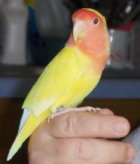
African Lovebirds Care
Peachface Lovebird Care
You have reached our lovebird care guide section. We've provided you with some very important and helpful
care tips, suggestions and general information about lovebirds to help aid you in taking proper care of a pet lovebird.
Lovebirds are very social and caring birds. They keep themselves busy pruning, sharing
food, playing and giving their companion attention, hence the name lovebird. Given the
right care and attention they can and do bond with people. Making them wonderful pets.
Most people think that lovebirds are suppose to be kept in pairs, otherwise they don't do
well and die. This is not true. They can be very happy and bond with those that take care
of them, when given the right amount of attention and care. Making it unnecessary to buy
them in pairs.
What is a lovebird and where do they come from?
Lovebirds are very social and caring birds that can and do bond with people
given the proper care and attention. Hence their name lovebird. Lots of people
believe that they should be kept in pairs but if given plenty of attention by their
owners, they can be happy bonding with those that take care of them and it is
unessicery to buy them in pairs. They eat a variety of foods daily, pellet based
diet, with seeds, fruits, vegetables and grains added.
A lovebird (genus Agapornis: from the Greek Agape, for love, and Ornis, for Bird) is a very social
and affectionate small parrot. A lovebird has a small stocky body with a little short blunt tail. They
have a large beak and are between 5 to 6 1/2 inches and weigh just alittle less than a pound. Lovebirds
are one of the smallest parrots in the world. They can be a variety of colors, although most are blue,
green, or lutino (yellow) but their color mutations can be several different colors. They can live up to
fifteen (15) years. There are nine (9) species of lovebird, eight of them come form Africa and the other
species originates from Madagascar. Some of them are sexually dimorphic including the
Abyssinian lovebird, the black-collared lovebird and the Madagascar lovebird. In the wild they live in small groups, sing and chirp, eat all day and they love taking baths. There are nine species of lovebird,
Peach-faced Lovebird, Agapornis roseicollis
Masked Lovebird, Agapornis personata
Fischer's Lovebird, Agapornis fischeri
Nyasa Lovebird, Agapornis lilianae
Black-cheeked Lovebird, Agapornis nigrigenis
Madagascar Lovebird, Agapornis canus
Abyssinian Lovebird, Agapornis taranta
Red-faced Lovebird, Agapornis pullarius
Black-collared Lovebird, Agapornis swindernianus
Eight of the nine species come from Africa, the other species originates from Madagascar.
Only some of the lovebird species are sexually dimorphic. This includes the Abyssinian lovebird,
the black-collared lovebird and the Madagascar lovebird. In the wild they live in small groups, sing
and chirp, eat all day and they love taking baths.
We breed Peach Faced Lovebirds (Agapornis roseicollis), sometimes called
Rosy faced Lovebirds. Peach faced lovebirds can be found living in the Namib
Desert, and other places in southwestern region in Africa.
What does a lovebird eat?
Lovebirds eat a variety of foods daily, pellet based diet, with seeds, fruits, vegetables and grains added.
Like humans, birds can become ill and even die eating spoiled, molded or foods with bacteria. Our lovebird babies have been fed and eat the following foods:
Cockatiel seed mixture
Avian Garden pellets for small birds
Millet / dried peppers
fresh vegetables / frozen vegetables thawed / fresh fruits
corn bread / birdie bread / unsalted cracker
cooked rice / pasta / oats / crushed cheerio
scrabbled egg with shell / boiled egg w/shell (chopped up)
Warning! Do Not Feed:
Please do not feed your bird, They are fatal foods and will kill your bird.
chocolate
alcohol
avocado
concentrated salt or sugar
What size cage do they need?
As you can imagine birds love space so buying the biggest cage you can afford is best and makes them the happiest. There are a few important factors needed to be considered before buying that large cage on sale or the cute looking decorative cage you seen in the paper.
The proper bar spacing measurements are very important for bird safety. Improper bar spacing can lead to injury for your pet bird. For lovebirds bar spacing should be 1/2" to 5/8" and never larger than 3/4".
The bigger the cage, the more space for your bird and it also allows room for toys.
Lovebirds need room to climb and play. You want your cage to be at least 24x16x16
inches. That size will house one lovebird comfortably.
Please Note: We normally have cages with or without stands, cage accessory kits and playstands available for purchase when buying a lovebird from us.
Where should I put the cage?
Your cage should be placed in an area that will allow your lovebird to always see and hear someone. Never place your cage in the kitchen or direct sunlight. Kitchens harbor lots of hazards and lovebirds can overheat in direct sunlight. Lovebirds are very hardy and tolerant to drafts but be careful of open windows, air conditions during summer and
Cold drafts during the winter.
What type of Perch should I buy?
Natural wood perches are best for your bird, the different shapes and sizes give your lovie
the exercise needed to keep their toes and feet healthy. Perches sizes for the lovebird varies 3/8 to ½ an inch in diameter and about 6 to 8 inches long.
Do lovebirds like toys?
Lovebirds love toys that are bright, colorful and busy. They love toys with things to do, such as, forge for a treat, swing, ropes, and bells. Beaded leather toys seem to be a great hit, along with bells and balls. Please avoid toys that have small strings that could get wrapped around your lovie's foot or become tangled. Always check toys to make sure they have not become frayed and hazzardous to your bird.
More Great Love Bird Care Information
|

indoor and outdoor bird aviaries
|